21 KiB
| title | author | theme |
|---|---|---|
| Introduction to Version Control Systems (GIT) for Economists | Will King (will@youainti.com) | league |
What Is Git?
What is Git?
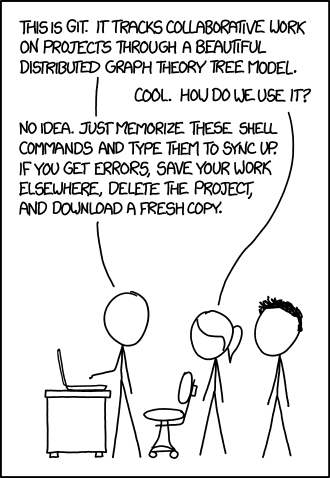
What problems are we trying to solve?
- How can we keep track of our work?
- How can we coordinate working with others?
Git is...
- a distributed version control system.
- a method of communicating changes in (text) documents.
Git is not..
- a programming environment
- a panacea for having to write your dissertation
Our goal
- Introduce how to work on the command line
- Introduce the basic commands to get started
- review how git works
- dive into normal tasks that you will face
Preliminaries
Have you installed Git and the assoicated tools?
| Operating System | Windows | MacOS | Linux |
|---|---|---|---|
| Git Source | git for windows | homebrew or Xcode | sudo apt/yum/pkg/zypper install git |
| Text Editor | Nano (comes with git for windows) | Nano (already installed) | Nano/Vim/Emacs |
Quick intro to the command line
- Used to be the way to control a computer.
- Very powerful.
- Not just one command line, there are multiple different "shells"
- Window: CommandPrompt, PowerShell, GitBash
- MacOS: Bash
- Linux: Bash
Why are we using the command line?
- Git was built to be used on the command line.
- All the instructions to fix problems are written with the CLI in mind.
Basic Bash syntax
command [arguments separated by spaces]
Pay attention to spelling, spaces, and capitalization.
command this has four arguments
command "this has one argument"
Navigating the command line
pwd: Print Working Directory.ls: LiSt.cd: Change Directory.nano: The text editor we will be using.
<details>
<summary>Instructors Notes</summary>
Get everyone to open bash at their home location. pwd, then talk about slashes etc.
Talk about spaces and quoting and escaping. Show a variety of paths.
</details>
Bash Activity
Prep: Download and extract the zip file I've provided.
- Open bash/gitbash in the extracted directory.
- Figure out what directory you are in.
- Start exploring the directories using the command line.
How is this similar to using your file browser?
<details>
<summary>Viewing files</summary>
To view files from the command line, you have a couple of options:
Vi/Vim, Emacs, Nano, etc.
The most basic one you can try is Nano.
Try typing nano [filename].
</details>
<details>
<summary>Instructors Notes</summary>
There are a couple of files with useful information.
Please go through them with the students as you explore the filetree.
It might be helpful to go through the directory outside of the command line too.
</details>
Getting help on the command line
When you run into issues on the command line, you need to know how to get help:
- internet searches (google, stackoverflow, etc)
- local resources
- command help pages
- man pages
- info pages
ls --help
man ls
info ls
<details>
<summary>Instructors Notes</summary>
Examine some of the CLI options for the command presented earlier.
</details>
Git Basics - Recording file changes
Concepts
- Repositories: A directory where you will be tracking changes.
- Snapshots: A copy of the state of the repository at a given time.
- Working Copy: Changes that haven't been recorded in a snapshot yet.
Initializing Repositories
Let's start a new repository.
- navigate to the extracted directory I gave you.
- create a new folder with a random name (don't use spaces!)
- open the command line in this new folder
git init .
The git init command turned the current directory (.) into a git repository.
If you were to type git init repo_name it would create a new directory named
repo_name/ and then turn it into a git repo.
Configurations
Now let's set some defaults that will make your life easier:
git config --global core.editor "nano"
git config --global user.email "your_email@example.com"
git config --global user.name "Your Name"
Writing Files (No git involved)
Ok, time to make some changes
nano README.txt
nano test.txt
Now let's see what git has to say:
git status
Marking Files for Inclusion (Staging changes)
Now let's stage these files (mark that we want to track these files)
git add README.txt test.txt
Now let's see what git has to say:
git status
Snapshotting changes (Commits)
Now let's take a snapshot. In git this is called a commit.
git commit
Commit Messages
- When writing a commit, you have the responsibility of explaining what happened.
- This helps teammates - including future you - know what you were doing and why.
- Let's write a meaningful commit.
Let's Practice
Let's make personal wiki's to keep track of what we are doing.
- navigate to the base directory that I gave you.
- initialize a git repo using
git init wiki - change directory to wiki
nano basic_git_workflow.txt- write something
- stage it
- write a commit message and commit it.
- add some more files and edits and repeat steps 5-7 a few times.
Git Log - noticing what happens
Lets take a look at what you just did.
git log
git log --oneline
Ready to move on?
- Is everyone comfortable and ready to move on?
- Have you committed everything you have?
- What questions do you have?
Git Concepts
How Git Works
Please take notes in your wiki; saving, staging, and committing as you go. Put each topic into it's own file; we will use them later.
If you run into issues, please let me know and I'll pause to help.
I owe this approach to explaining git to Tom Preston-Werner's Git Parable
Snapshots
When working with a project, you might want to know the history of that project. A simple way to do this is to make copies or snapshots at regular or important points.
Imagine I am writing a novel. I start by writing "It was a dark and stormy knight." In order to avoid loosing my work, I save my working version, and then make a copy to google drive called
novel-(date1).docx. Later I decide to fix my error and change it to "It was a dark and stormy night." I then save my working version and make a second copynovel-(date2).docx.
Storing Objects
This is the basic way git works.
Each time a file is committed, a copy is saved to a hidden directory in the
.git folder.
Staging the file marks that you want to save the current version of the file.
<details>
<summary>Explore</summary>
In your wiki, stage a change for a file.
Look at 'git status' to see what has been staged.
Now change the same file, and check 'git status' again.
The old version is staged, but the new one is not.
</details>
How does git name each file version?
There is a computer science tool called a hash function. It allows us to give each version of a file a (nearly) unique name that depends on the file's contents.
- Navigate to the
bash_exploration/directory. - run
sha1sum c.txt - Does it match
cf44e4a24958c62790979deaad545d23c8fbe98e? - Edit
c.txtby removing the '(txt)' part of the first line. - What is the new sha1sum?
This is called a Content Addressible System, because we can address each unique version of our content.
Incremental Snapshots
Imagine if I had 100 different files, and I was taking full snapshots each time I changed one or two of them. I would end up with a lot of copies of the same content.
If I wanted to save on storage space, I could instead copy just the versions that I changed.
This is what Git does. Each snapshot contains just a list of the staged files, i.e. the files that we have said have changed in an important way.
This is done by saving the staged objects with SHA1SUM names, and then writing a small file that contains the filenames and SHA1SUM names of the change. This is what committing a change does.
Constructing a DAG - Commit Parents
Now notice one problem with Incremental Snapshots. If I miss a snapshot somewhere, I am left without those changes. So, I need a way to know which previous snapshots are required to get to a specific state.
The solution is to allow commits to include information on 'parent' commits. Now we can draw a graph of how we get to a specific state.

git log --graph describes the commit dag.
Confusing DAGS
Imagine the following commit DAG

How can we know what state we should have?
Pointers (branches, tags, HEAD)
In CS, a pointer is something that records an address to something else.

Three common types of pointers: Branches, Tags, and HEAD
Branches
A branch is a flexible marker that simplifies isolating work from different parts of the codebase. It is used to track areas of work. For example, if I:
- Wanted to experiment with something without messing with the main code.
- Was trying to fix a bug and needed to add a bunch of debugging.
- Wanted to try implementing a specific advisor's suggestions before going all in on it.
- Try to incorporate all the work of a collaborator who's work I'm going to need to fix.
When you create a commit, a branch will change to point to the new commit.
Branches are cheap, use them.
Tags
A tag points to a specific commit. They are useful for:
- Marking releases or versions of software.
- Identifying a commit where an error was added.
- In Economics: Marking the version of an analysis you presented in your dissertation.
HEAD
Points to the commit that your current working copy is based on.
You may see a detached HEAD error. No the revolution hasn't started yet, you just got your HEAD pointing to a specific commit instead of a branch pointer.
Return of the DAG
- How can we know what state we should have?
- What is HEAD pointing to? What should it be pointing to?
Conflicts
Take a look at commit 10.
Notice how it has to handle the cases where
Commit 5has removedb.txtbutcommit 9hasn'tCommit 5andCommit 4have conflicting edits ofe.txt
Notice how it has to handle the cases where
Commit 5has removedb.txtbutcommit 9hasn'tCommit 5andCommit 4have conflicting edits ofe.txt
This is called a conflict, where the same file has had different changes happen in different branches.
To handle this, Git asks you to resolve it, choosing what should be kept or removed. Resolving a conflict is called a merge.
Merging is the main skill we want to develop.
Rewriting History - the DAG can be modified (kind of)
Because the DAG is just a bunch of records pointing to other records, you can rewrite it, BUT if you rewrite a copy of the DAG and your coworkers don't, then you're in for a world of hurt.
This is what advanced GIT consists of: rewriting the commit DAG so that it clearly, cleanly, and consisely represents how the codebase grew.
We will only take the briefest of looks at one way to do that.
How to work with Git
Review of basic git workflow.
Remember!
- init repo
- add and edit files
- stage files
- commit files
- repeate 2-4 as many times as needed.
Git Log
You can inspect what has been going on using:
git log
git log --graph
git log --oneline
git log --oneline --graph
...
Git Help
If you ever forget what options are available for git:
git --help
git [option] --help
For example
git log --help
Let's Start Branching
To create a new branch, either of the following work:
git checkout -b [new_branch_name]
git switch -c [new_branch_name]
In our wiki repo, let's create a branch named spellcheck
git checkout -b spellcheck
Now check which branch we are on
git branch
git status
Swapping between branches
There are two ways to change between branches
git checkout [branch]
git switch [branch]
git switch: only used to change branchesgit checkout: does so much more
Merging Branches (FF Merges)
Ok, let's do the following:
- add a file in our spellcheck branch
- switch to the main branch
- merge spellcheck into main
git switch spellcheck
echo "hello world" > n.txt
git switch main
git merge spellcheck
git log --graph --oneline
This is called a fast-forward merge.
Creating Conflicts
Conflicts are not bad, they are inconvenient and necessary.
A conflict occurs when two commits have different versions of the same file(s).
Let's create a conflict in our wiki repo.
git checkout spellcheck
nemo favorites.txt #Talk about your favorite color
git add favorites.txt
git commit -m "write an actual description"
git switch main
nemo favorites.txt #Talk about your favorite food"
git add favorites.txt
git commit -m "write an actual description"
git log --graph --oneline
git merge spellcheck
Three Way Merges
In this case we have a warning message: TODO
We have two conflicting changes to the favorites.txt file.
We need to choose between them.
git status
nemo favorites.txt
Note the symbols "<<<<<" "======" ">>>>>". These tell us what the differences are between the commits
To resolve the commit:
- we edit the files in conflict to get what we want from them.
- stage the changes.
- commit the merged files.
Practice (5 min)
- checkout main and start writing some more about your favorite food.
- checkout spellcheck and start writing more about your favorite color. Notice that spellcheck didn't get the changes from main.
- merge spellcheck into main (checkout main then
git merge spellcheck) - Resolve the merge.
Introducing a normal workflow
Usually, you have branches that represent "states" and branches that represent areas you are working on.
Consider the following branches
main: This is the branch that you are using to present work that you consider somewhat complete, i.e. when you have a first draft of your data processing code, or the output data.data_processing: This is where you write your data processing code, e.g. a web scraper and data munging tools. It might include a copy of a.csvfile or.rdatafile that you will use in the analysis later.regression_analysis: This is where you develop the analysis that you will apply to the data you have. This will require pulling the most recent data to analyze.
What this might look like.
- init repo
- write things such as README in main.
- Create
data_processingbranch- Get
data_processingto a working state (committing along the way).- merge
data_processinginto main.- create a branch
regression_analysisfrom main.- start writing your analysis, committing along the way.
- Notice that the data is incorrect.
- checkout
data_processing- fix the error that is giving you the incorrect data
- merge the fixes into main with a helpful description.
- checkout
data_analysisand merge the fixes from main.- finish your analysis with the corrected data
- push analysis to main.
- Start a new branch
reportand begin writing your report.
View from main street
To someone looking at your main branch, they would see.
- You created data processing tools.
- You fixed an error in the data processing tools.
- You then used that corrected data to perform an analysis.
Quick Mention - Squashes
Sometimes when you have a bunch of small rough changes, you might want to turn them into a single (nice looking) commit.
This is called squashing
git merge --squash [branch name]
For example, if we had 3 commits in spellcheck, we could squash merge them into main by:
git switch main
git merge --squash spellcheck
This is one way to rewrite the DAG. It depends on the fact that branches are disposable. There is no need to keep a branch around after it is squashed.
Remotes
Git is a Distributed VCS
We have focused on the Version Control System portions of Git. Now it is time to look at how to use it as a "distributed" VCS and how to collaborate together.
Git originated as a tool to develop the Linux Kernel. It is now the most popular VCS in the world. This is - in part - because people can work on the same thing without getting in each other's way.
Because Git is flexible, it supports many different workflows. When you work with an established team, learn their workflow.
Adding a local Remote
A remote is somewhere that git will fetch commits from. A repository can have more than one remote.
A local remote is a remote that is on the same computer, e.g. a separate HDD or USB drive.
How would we add a remote?
git remote --help
- e.g.
git remote add usb_drive /path/to/usb/drive/repogit clone --helpgit clone /path/to/onedrive/folder/with/repo
Remote workflow
# Begin by fetching chagnes
git fetch remote/branch
# Merge changes from remote branch into your current branch
git merge remote/branch

# Work like normal

# Give your updates back
git push remote/branch
There is a command that combines the fetch and merge steps:
git pull remote/branch
Exercise
- I've got a usb drive that we can pass around.
- It already has a git repo on it.
- We are going to create a joint wiki.
- Each person chooses a topic or two from their personal wiki.
- We will pass around the USB a couple of times, allowing people to
- clone the repo
- add their topics
- push to the repo
- We will then divide into editing teams and I'll assign you a topic or two that you will edit.
- As we pass the USB around, you'll get a chance to pull and push changes.
- Talk as an editing team, but don't share computers.
Git Forges
When people think of git, they usually think of github.
Git is to Github as video is to YouTube. Quoted in Hari-up
A Git Forge provides
- A non-local git remote
- features such as bug trackers and wiki's to help coordinate software development.
Demo Git Forge
I have a git forge that we are going to practice using
We are going to
- add it as a remote
- continue the experiment using the remote.
Cloning non-local remote
- Login
- Getting the URL
- add the remote
- Making branches
- Pushing branches from CLI
- Merging to Main.
[!NOTE] I will be removing your access to this git remote sometime soon. You will still have a local copy of the wiki though!
How have I used Git in my work?
Tracking Code and Data
- I have used git to track my code for both data processing and data analysis
- If I were taking a class on econometrics where we have to code up some analyses, I might keep track of it in Git. A folder for each homework, tagging it right before submitting it. I would only use one branch probably.
- I have used git to coordinate work for an econometrics group project.
Latex Development
- I am currently working on my disseration in LaTeX.
- I use git to be able to revert mistakes and sync work across multiple computers.
Final Thoughts
What should you continue learning?
- .gitignore files - Sometimes you don't want to stage a whole class of files.
A
.gitignorefile tell git to not to stage them. For example, if you are doing an analysis in python, you might get a__pycache__/directory. If you put a line that says*/__pycache__/in your.gitignore, it will not be suggested that you stage anything in that directory. - Git LFS - Saving large files that are not text can be difficult, such as
when you are saving
.pdf,.jpg,.png,.xlsx,.docx, or.zipfiles. Any change will cause the whole thing to be resaved, and this can quickly add up to lots of storage being used. Git LFS does a couple of things to reduce how much storage will be used. - Branching Strategies - Knowing how to setup and use branches properly is a powerful thing. There are tons of blogs with information from different companies explaining how they are doing it.
- Merging and Rebasing tools - There is so much to do here.
Most of All
Practice!
Feedback
- What questions do you have?
- What would you like to keep practicing?
- How could I improve?